May 8, 2026
Not because the thought leader are wrong but because the diagnosis is wrong. We have built an enormous industry based on a mistake. We keep treating a timing problem like it's a skills problem. We focus on communication training. Executive coaching as currently practiced props itself up on things like emotional intelligence workshops, difficult-conversation frameworks, and crucial-conversation scripts. Billions of dollars, thousands of consultants, decades of books.
The leaders I work with still can't have the conversation.
Not because they don't know the words. They've read the books. They've done the training. They can recite the frameworks. Many of them can coach other people through hard conversations with real skill. What they can't do is step into their own hard conversations. The one they've been aware of for six months, or eleven months and in the case I keep thinking about from last year to seven years.
The field has been asking the wrong question. The question isn't how do leaders have better conversations? The question is, why don't they have them at all, when they know exactly what needs to be said?
That question has a field. It doesn't have a name. So I'm going to name it.
Leadership Avoidance and Execution Psychology.
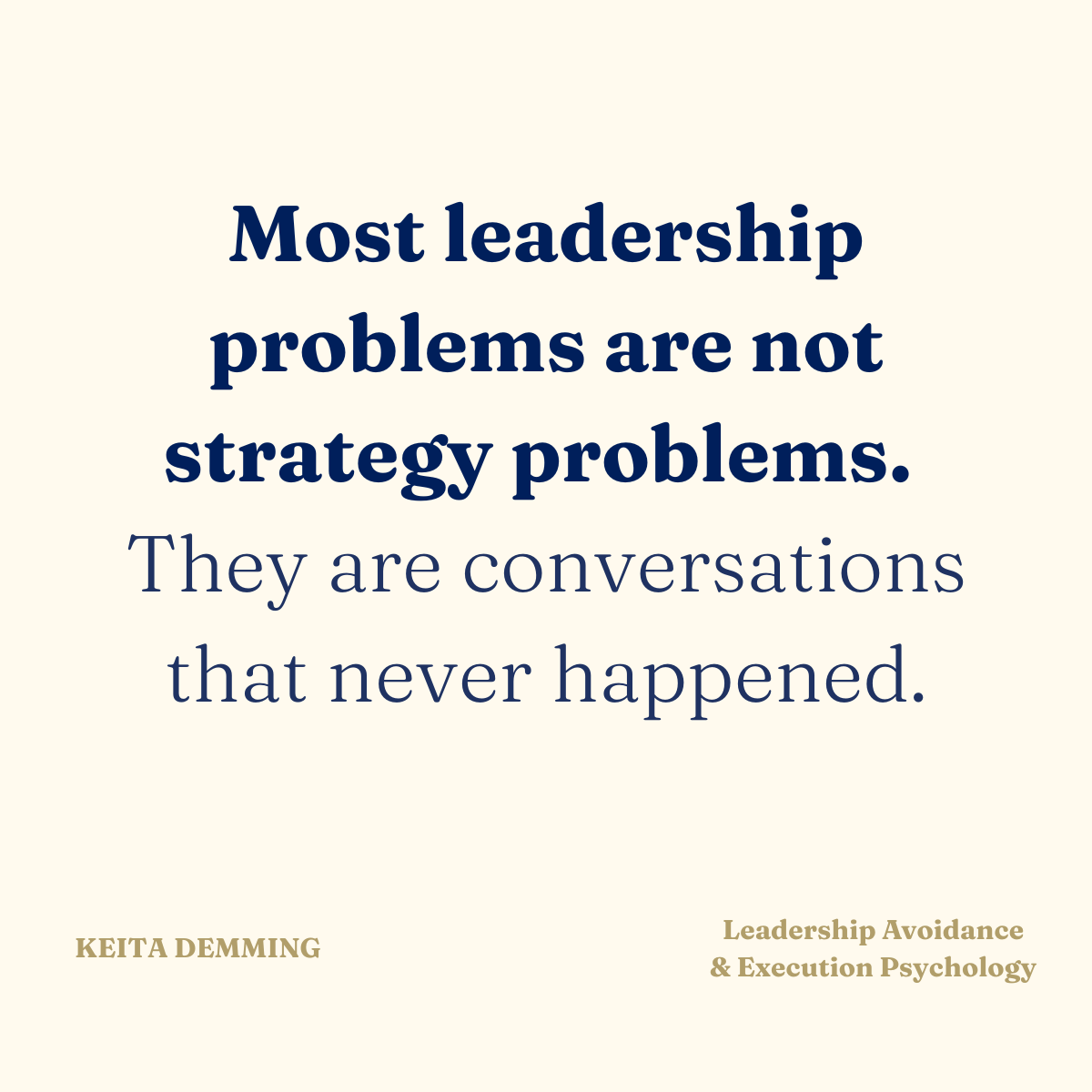
The premise is simple enough to state in one sentence: Most leadership problems are not strategy problems; they are conversations that never happened.
The sentence sounds like a slogan. It isn't. It's a claim about where organizational costs live and a claim that almost nothing in the current leadership-development industry is set up to address.
What the old paradigm gets wrong
The existing category - let’s call it "communication and difficult conversations” - is built on an assumption that, once you look at it directly, is obviously false. We assume that the gap between a leader and the conversation they need to have is a knowledge gap. Give them better language. Better scripts. Better emotional tools. Close the knowledge gap, and the conversation happens.
Every practitioner I respect in this space has noticed the same thing: It doesn't work. Or rather, it works for the 15% of the problem that actually was a knowledge gap, and leaves the other 85% untouched. The 85% is leaders who already know. They've known for months. The conversation is written out on a Google Doc somewhere. They've rehearsed it with their coach. They've role-played it with their spouse. And it still hasn't happened.
What the old paradigm misses is that the delay isn't a bug. The delay is the behavior. It's what the nervous system produces when something about the conversation threatens the leader's status, belonging, identity, livelihood, and the one almost every book skips, the fear of what it will feel like to be in the room when the other person reacts.
Call that last one Emotional Flood. It's not fear of the content. It's fear of the experience. Fear of the tears, the rage, the breakdown, the composure lost. Most of the leaders I work with who have been delaying for more than six months are not avoiding the sentence. They're avoiding the room.
You cannot script your way out of Emotional Flood. You cannot framework your way out of it. And that's why the communication industry, despite its size and earnestness, keeps producing leaders who complete the training and still don't have the conversation.
What the delay actually costs
Here is what I've watched delay do, over and over, across hundreds of leadership teams.
A CEO notices a tension with a co-founder in month one. By month four, the tension has become an interpretation. A story about the co-founder's character. By month nine, the interpretation has calcified into resentment that no longer has a clear origin. By month eighteen, the partnership is quietly ending, and nobody in the room can say exactly when it broke.
The conversation that would have fixed it in month one would have taken twenty minutes. The conversation in month eighteen takes a year and a legal team, and the damage doesn't fully repair.
This pattern — tension → avoidance → interpretation → resentment → confrontation — isn't unique to co-founders. I see it in CEO-COO dynamics. In board relationships. In family enterprises across generations. In every senior team where one person who has something to say to another and keeps not saying it. The curve is predictable. The cost compounds.
And the cost isn't just relational. It's strategic. The priorities that don't reset, because the performance conversation didn't happen. The pivots that don't land, because the executive who needed to be moved wasn't. The hires that don't close, because the partner issue wasn't resolved in time to tell the candidate a coherent story. When leaders say "execution is slipping" or "the team has lost clarity," they are, almost always, describing the downstream effect of conversations upstream that didn't happen.
This is why the field needs a new name. "Communication" is too small for what's at stake. "Difficult conversations" treat the symptom. What we're actually looking at is the intersection of psychology, timing, and organizational execution. This is a category that properly belongs to no existing discipline.
What the new paradigm claims
Leadership Avoidance and Execution Psychology rests on four claims, each of which contradicts something the existing field tends to assume.
One: the real skill is moving sooner, not talking better.
The variable that separates leaders whose organizations execute from leaders whose organizations stall is not the quality of their language. It's the speed with which they close the gap between noticing something and naming it. I call this gap the Leadership Gap. The discipline of closing it is what actually distinguishes effective leadership under pressure.
Two: delay is protective behavior, not character weakness.
When a capable leader avoids a conversation for nine months, they are not failing at discipline. They are doing exactly what their nervous system is designed to do when it perceives threat. The leadership-development industry's tendency is to frame avoidance as a moral failure. The frame often goes something like, you should just be brave, you should just have the conversation. This frame misunderstands the mechanism. Avoidance is loyal to something. Until you know what, you can't change it.
Three: regulation precedes conversation.
The reason scripted approaches fail is that skill disappears outside the leader's window of regulation. A CEO operating from either the hot state (attack, control, urgency) or the cold state (shutdown, withdrawal, delay) cannot access the conversational skill they need in that moment. Which means the first move is almost never the sentence. The first move is getting the leader back inside the window where the sentence becomes available.
Four: the cost of the conversation is almost always less than the cost of its absence.
This is the claim that most leaders intellectually accept and emotionally resist. The accounting is straightforward. I can show it to you on a whiteboard in ten minutes. What makes it hard is that te cost of the conversation is vivid and immediate, while the cost of its absence is diffuse and delayed. So we keep paying the second one because the first one feels worse in the moment. It isn't. It's usually ten percent of what the avoidance will cost across the following year.
Where this goes
A new field needs more than a name. It needs a diagnostic, a vocabulary, and a body of evidence.
The vocabulary exists. Across twenty years of practice I've mapped a set of frameworks that describe the mechanics of avoidance and the moves that interrupt it.
The Five Delay Narratives: The stories leaders tell themselves to justify waiting, and the sixth one ("I'm working on it") that appears the moment leaders start studying the other five.
The diagnostic exists. The Leadership Avoidance Diagnostic identifies a leader's primary archetype, names what they're protecting, and makes visible the specific conversations they're most likely to be delaying right now. We built it because leaders kept telling me they could feel the pattern but couldn't name it. Naming a pattern is the first move in interrupting it.
The evidence is what we're building next. Over the coming year, as the diagnostic runs across thousands of leaders, a picture will emerge of how avoidance actually distributes across industries, roles, and life stages. What the primary protections are for founders versus corporate executives. What the patterns look like in family enterprises. Which archetypes compound together and which cancel out. When we've run it across enough leaders, we'll publish what the data shows. That report will be the first empirical map of the field.
And the book is coming. Have Hard Conversations Faster is the full architecture. Every framework above, the practices that train the reflex, the cultural work that makes early truth-telling survivable in a team. It's under contract. It will be published next year.
But you don't need the book, the diagnostic, or the report to start. You need the claim.
The claim
Most leadership problems are not strategy problems. They are conversations that never happened.
The conversation you've been putting off for three months is not a communication challenge. It's a delay, and the delay has a cost that is, right now, larger than the cost of the conversation itself. You know which one I mean. You've known for a while.
There is a field forming around the question of why capable leaders wait too long, what it costs them, and how they move sooner. I'm naming it Leadership Avoidance and Execution Psychology because the old name (Communication), is too small for what's at stake, and because the field needs a name that tells the truth about what the work actually is.
You do not need another framework; you need to have the hard conversation sooner.
In all that we do, let us seek wisdom, discipline, courage & justice.
Be well,
Keita



.png)
.png)
.png)
.png)
.png)