May 1, 2026
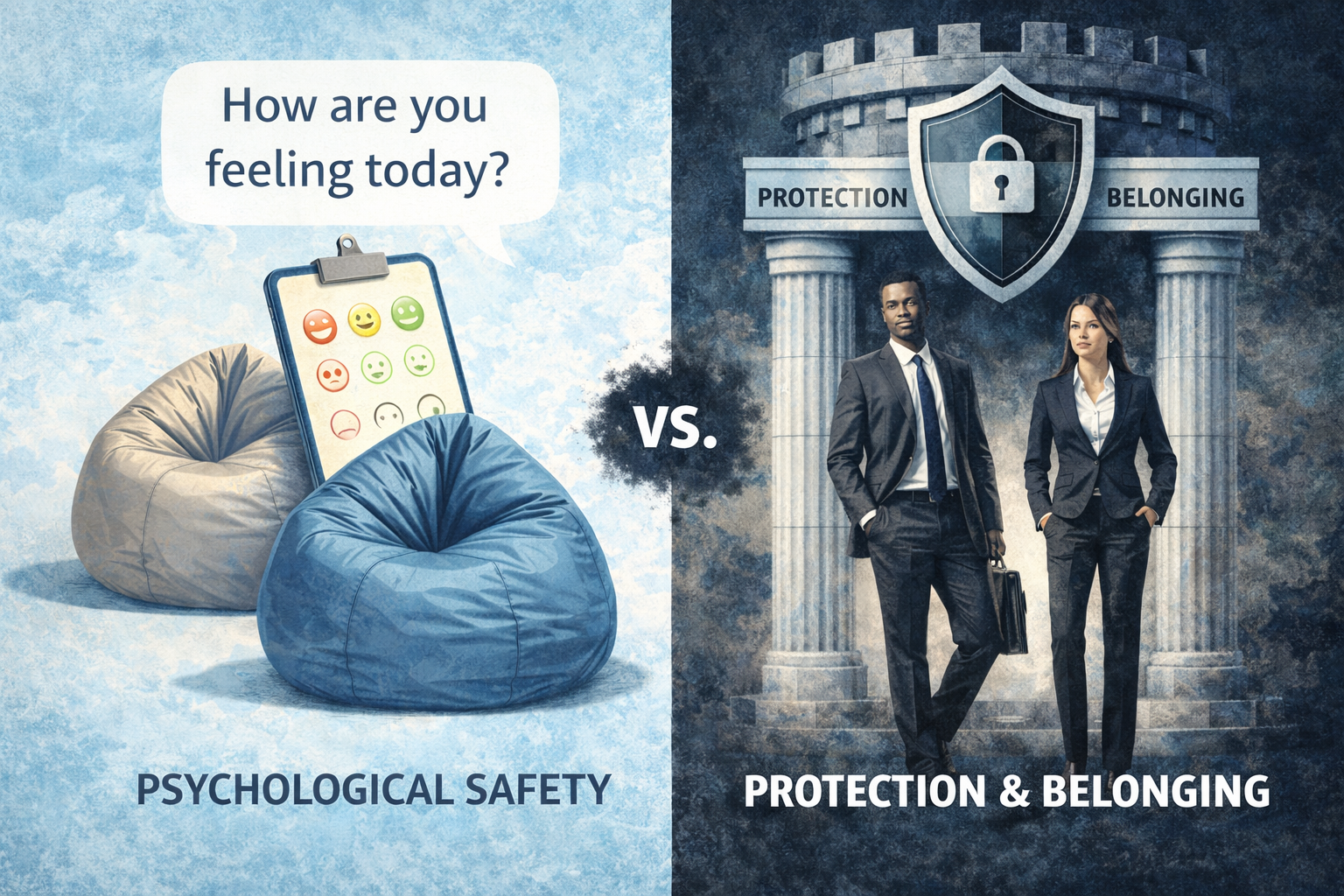
For years, leaders have been told the same thing:
“Build psychological safety.”
It sounded smart.
It sounded progressive.
It sounded… harmless.
And now it means almost nothing.
Like most management buzzwords, it has been softened, diluted, and turned into wallpaper. Beanbags. Surveys. “How are you feeling today?”
Meanwhile, performance is flat and politics are rising.
So let’s retire the phrase.
What actually matters is simpler. Older. Harder.
Every human system runs on two ancient questions:
Am I protected here?
Do I belong here?
If the answer to either is no, performance drops.
Not because people are fragile.
Because biology wins.
Why “Safety” Was the Wrong Word
High-performing teams consistently outperform when people can:
Call it psychological safety if you want.
But that was never the real mechanism.
The real mechanism is this:
When people feel exposed, expendable, or politically vulnerable, they protect themselves first.
And self-protection always outranks innovation.
Always.
What This Looks Like in Real Organizations
In wealth firms:
Junior advisors nod and comply.
They see problems. They don’t name them.
Because being wrong feels risky.
Rainmakers hoard control.
Delegation feels like exposure.
In construction companies:
Estimators don’t flag weak margins.
Field staff stop escalating issues early.
It is safer to stay quiet than be blamed.
In family enterprises:
Silence replaces tension.
Founders equate disagreement with disloyalty.
Next-gen leaders learn to keep their heads down.
None of this is incompetence.
It is protection.
The Hidden Cost of Self-Protection
When people are in self-defense mode:
You get order.
You do not get ownership.
And ownership is what scales.
The Core Principle
You cannot demand accountability from people who feel disposable.
You cannot build ownership in a system that triggers self-defense.
Belonging does not mean comfort.
Protection does not mean softness.
It means:
That is structural protection.
And structural protection creates courage.
Why This Framing Works Better
“Psychological safety” sounds like a perk.
Protection sounds like leadership.
Belonging sounds like loyalty.
And loyalty drives discretionary effort.
People work harder, think deeper, and take smarter risks when they know:
“I won’t be punished for telling the truth.”
“I won’t be humiliated for trying.”
“I won’t be discarded when it’s inconvenient.”
That is not softness.
That is operational strength.
What Strong Leaders Actually Build
Strong leaders do not create “safe spaces.”
They create systems where:
People are not coddled.
They are protected from nonsense.
The Bottom Line
When people are protecting themselves, they are not protecting the business.
Belonging is not a feeling.
It is a performance multiplier.
Compliance comes from fear.
Ownership comes from protection.
If you want accountability, build protection first.
Not with slogans.
With structure.
With clarity.
With courage.
That is leadership.
In all that we do, let us seek wisdom, discipline, courage & justice.
Be well,
Keita



.png)
.png)
.png)
.png)
.png)