December 5, 2025
Raise Your Standards, Shrink Your Starts
Most people walk into a new year with big goals and a fresh burst of motivation, then feel like they have “already blown it” by February. The core problem is not that they are lazy or broken; it is that their minimum standards are still “good enough” instead of “this is just who I am now.”
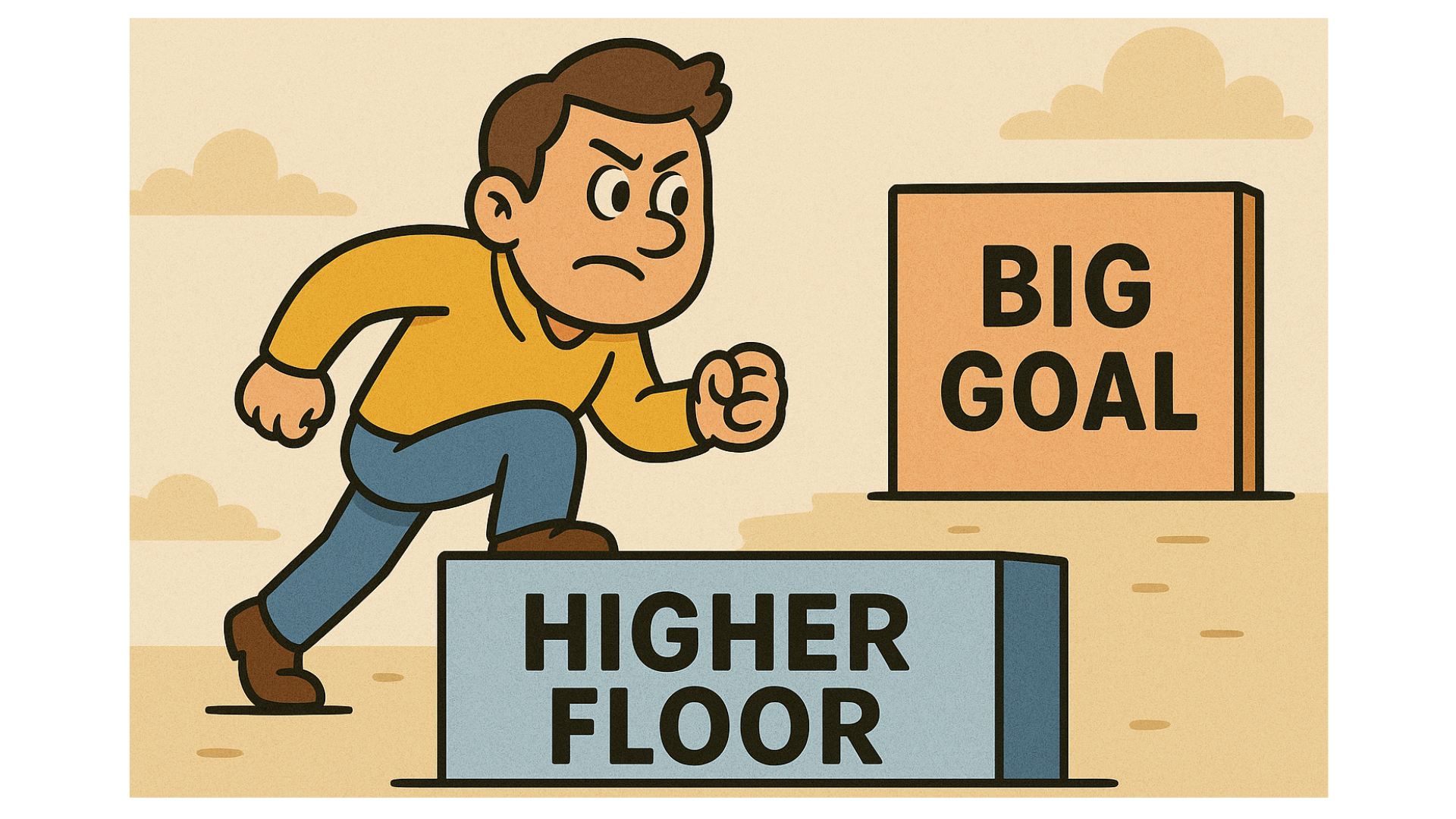
In 2026, the real unlock is not a bigger goal, but a higher floor and smaller, more realistic starts that you can hit even on your worst day.
Why Discipline Bleeds Into Everything
When you choose one demanding goal and take it seriously, prepping for a race, a bodybuilding competition, or a very specific business target, everything else starts to tighten up around it. Research on self-control and habit formation shows that consistent discipline in one area often spills over into better choices with sleep, food, money, and time, because you start to see yourself as the kind of person who follows through.
This is why people who commit to a structured training plan or daily prospecting routine often report being more productive, more focused, and even calmer in other parts of life. You are not just changing what you do; you are changing who you believe you are, and your actions in other domains begin to match that new identity.
Standards as Floors, Not Ceilings
Most people frame their goals as peaks: “run a marathon,” “hit a revenue number,” “lose 20 pounds,” or “post on LinkedIn every day.” Peaks are inspiring, but what shapes your year is the floor, the worst day behavior you are still willing to accept from yourself. A floor is the minimum standard you keep no matter how busy, tired, or unmotivated you feel.
Think of standards like this:
Once you raise your floor, you no longer fall all the way back to zero when life gets messy; you bounce off a higher baseline instead. Over time, that baseline becomes your new normal, and you can raise it again in small increments, 20 km, then 25, and so on.
Start Tiny (Smaller Than You Think)
The fastest way to sabotage a new standard is to make it too big at the start. Studies on habit formation and tiny habits show that small, easy actions repeated daily are more likely to stick than ambitious routines that depend on high motivation. A “tiny habit” feels almost embarrassingly small: 30 seconds of running, 5 push-ups, one outreach message, one glass of water, or two minutes of journaling.
Tiny works because:
As you repeat a tiny habit, the neural pathways for that behavior strengthen and it starts to require less effort and willpower.
Eventually, you feel strange if you do not do it, and at that point it is easy to gently increase the volume, add one more push-up, one more minute, or one more kilometer.
The Invisible Phase: Compounding in the Dark
At first, it will look like nothing is happening. Your body, bank account, and calendar may look almost the same in week two as they did in week one, which is where most people give up and tell themselves the habit “isn’t working.” Behavioural research shows that habit benefits are front-loaded in the brain (identity, confidence) and delayed in visible outcomes (weight loss, speed, revenue).
Think of this phase like planting bamboo: roots grow underground for a long time before anything breaks the surface. If you can tolerate that invisible period and simply keep your tiny standards, there is a point where progress suddenly feels faster and more obvious, the beginning of your personal “hockey stick” curve.
Make It Real: A 2026 Micro-Standards Exercise
To turn this from theory into a better year, run through this quick exercise and actually write your answers down.
1. Choose one anchor discipline for 2026. Pick just one area to start:
2. Set a floor you can always hit . Define a minimum that you can do even on your worst day:
3. Make the start tiny . Shrink the start until it feels almost too easy:
Track only one question. For the first 30 days, ask only: “Did I keep my standard today; yes or no?” A simple checkbox on a calendar or notes app is enough; the goal is to build a streak and a new identity, not to hit perfect metrics.
Choose your anchor discipline and write down one floor you will keep for the next 30 days, then share it with someone so it stops being an idea and becomes a standard.
In all that we do, let us seek wisdom, discipline, courage & justice.
Be well,
Keita




.png)
.png)
.png)
.png)